Introduction
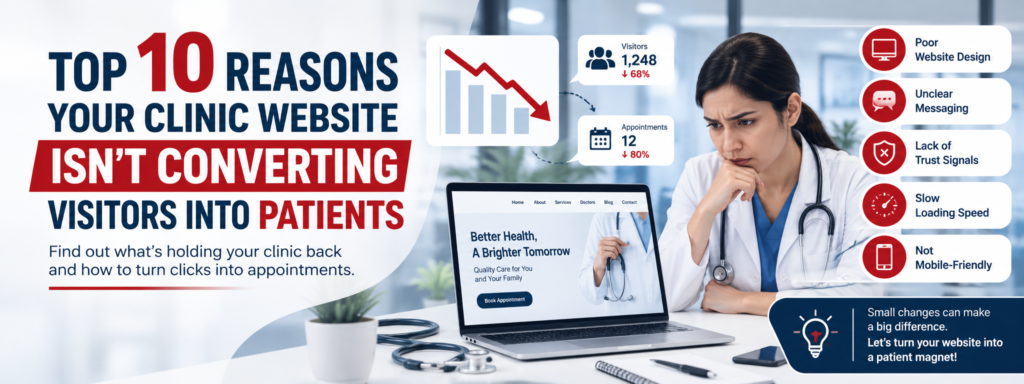
There is a very high probability that you receive hundreds or perhaps thousands of visitors to your clinic website every month; however, if none of them make any booking, you are definitely not the only one making such a mistake. Many clinics spend a lot of time building an outstanding and professional website but fail to take care of some important elements that play a vital role in making decisions by patients. As the world of healthcare has turned digital now, you must remember that your website is the face of your clinic in the internet age. Not optimizing your website properly will cause visitors to leave your site immediately and go to your competitor.
Why Website Conversion Matters for Healthcare Practices
A website for a clinic is not just an internet brochure; it’s a patient generation channel. Each page needs to nudge the visitor towards doing something, such as scheduling a visit, contacting your clinic, or asking a question.
A high website traffic is worthless if visitors are not converting into patients. Website optimization increases trust, provides answers to your patient’s questions, highlights your expertise, and enables your patients to contact your clinic.
Website optimization will allow you to generate more patient inquiries without increasing your marketing budget.
1. Your Website Loads Too Slowly
Website speed is important when it comes to making a good user experience and deciding on which hospital to choose. The majority of users do not spend too much time loading web pages; they want everything to be fast and quick. Therefore, it is likely that people will just close your website and find another one because it was not quick enough. A website with a high bounce rate does not lead to the generation of leads and can negatively influence the ranking of the website.
In order to speed up the website, you need to optimize it. Image compression and minimizing the amount of script and code used are essential in speeding up the website. Selecting a good hosting company will allow your website to load even faster and work more efficiently. It is necessary to monitor your website and speed it up regularly because you need to give your patients an opportunity to have the best experience on your website.
2. Poor Mobile Experience
In today’s world, most of the people would prefer to look up the hospitals, clinics, and other healthcare facilities via their smartphone or tablet. When your website isn’t optimized for accessing from mobile phones, visitors might experience certain difficulties while browsing your site for some important information. Such people would have difficulties while navigating your site, looking for the needed information, and even making an appointment. As a result, the conversion rate of your site would be poor because people would leave your site and look for some other websites.
If you are planning to develop a website for mobile phones, the main thing that you need to consider is the responsiveness of your website. Fonts should be of sufficient size and buttons should be big enough for easy clicking. In addition, it is necessary to consider the convenience of looking for important information on your website.
3. Confusing Navigation
It is essential that people will be able to find all the necessary information concerning your company’s activities fast and without any troubles. In case if the website features hard-to-use menus, complex interface and chaotic layout of its elements, clients are likely to become confused and simply leave the page without taking into consideration all your offers and even without making an appointment.
A good website must provide its visitors with an intuitive navigational system that allows them to easily find all the needed data. Arrange your content in clearly marked menu categories and allow visitors to find pages devoted to the description of your services, the profiles of doctors and all other essential pages. Promote the services you are proud of on the main page and other important landing pages of your website. It will also be useful for you to make sure that appointment booking buttons and other calls to action are easily available on all pages of your website.
4. Lack of Trust Signals
Trust is an important aspect of health care decisions. Patients want to be assured that the services they will receive are being provided by experienced and professionally trained doctors even before they decide to make an appointment. If you do not provide enough trust signals on your website, the patient may think twice before using your health care services despite their quality.
The best way to build trust is by making trust signals evident on your website. Well-written profiles of doctors which contain their credentials, experience, specialization and certification will give the patient a chance to choose a doctor who can handle his case. Patient testimonials and reviews act as social proof that assures patients of the kind of care they will receive. Industry awards and certifications further boost your clinic’s reputation and professionalism. When appropriate and ethical, before and after pictures of your patients’ treatment can show the effectiveness of your treatment.
5. Weak Call-to-Action (CTA)
If your website receives many visitors, there is little chance that they will proceed without being prompted. Contact forms that are difficult to find, booking buttons that are hidden, and cumbersome process of enquiry are creating barriers, which deter patients from contacting your clinic. When it is difficult for patients to find how to contact your clinic or book an appointment, they simply go away in search of another clinic with better website.
In order to achieve more effective conversions, use calls to action that prompt patients to perform actions on your website. Buttons with calls such as “Book an Appointment”, “Schedule Your Consultation”, “Call Our Clinic Today”, “Request a Callback” provide clear information about what patients should do on the website. These calls to actions should be placed in many places on the website – homepage, pages devoted to services, pages devoted to doctors, and even after informative pieces.
6. Outdated or Thin Content
Before visiting a doctor, many patients try to find reliable information on the topic. They might want to know something about their symptoms, possible treatments, healing period, prices, and prevention measures. If your website doesn’t offer any useful and clear information, the visitors will simply leave the page and seek for additional information somewhere else, perhaps choosing another more informative medical service provider.
Educational content can be used effectively not only as a way to answer patients’ questions and build their trust in your healthcare skills but also as a great marketing tool for your clinics or hospitals. Frequent updating of health blogs, detailed treatment descriptions, FAQ, doctors’ insights, and advice on how to prevent certain diseases is beneficial for both patients and your clinic – by providing educational content, you’ll increase your website’s search ranking and attract more visitors.
7. No Online Appointment Booking
Nowadays, modern patients demand convenient and available services that are always ready to assist them when needed. If you make your clients contact the clinic or hospital in order to arrange an appointment only during office hours, then most of them will prefer to put off the process or find another medical institution that offers a faster booking process.
Easier appointment booking will definitely have a positive effect on the overall patient satisfaction and will increase the number of conversions. Booking forms available for the internet booking will allow patients to arrange consultations around the clock, while WhatsApp booking options will help to communicate with your clinic using a fast and convenient messenger. Click-to-call will enable patients who use a smartphone to contact you immediately with just one click. Immediate sending of confirmation emails or messages will give patients an assurance that their appointment was arranged correctly and all necessary details were sent.
8. Poor Local SEO
Having a strong online presence locally is vital when it comes to acquiring new patients. Majority of the patients look for health care facilities close to them using location terms like “dentist near me”, “skin clinic in Kolkata” or “pediatric clinic nearby”. If your clinic/hospital does not come up on those search results, chances are that your facility will not be discovered and patients will prefer another facility that has good local SEO.
Optimizing the Google Business Listing is one of the best ways through which potential patients can easily locate your clinic and contact you. Optimize the listing with relevant information about your practice including your photos, business timings, patient reviews and most importantly keywords that match the locations that your clinics operate in. Creating location specific pages for all the cities or locations where your clinic operates will make sure that your local SEO is strong. It is important that you are consistent with your NAP information across your website and social media channels.
9. Negative or Missing Patient Reviews
Today, online reviews have become one of the most significant factors that play a role in making the right choice regarding a clinic or hospital. Patients tend to go through the reviews of previous patients to see what kind of experience others had at a certain clinic and what kind of services they received there. A clinic that provides the best services may face some difficulties when it comes to attracting new clients since it does not have enough or fresh reviews on different websites.
In order to create a good online reputation, it is necessary to take a number of steps to make sure that the reviews will be positive. First of all, it is important to encourage your satisfied patients to leave their reviews about your clinic on trusted websites like Google, Facebook, and other directories related to healthcare. Secondly, you should always react professionally to each and every review regardless of its type – you should thank the person for his/her feedback.
10. No Conversion Tracking or Analytics
Many clinics find it challenging to enhance their website performance due to the lack of understanding of where patients are coming from or why they do not convert while visiting the website. Lack of proper data makes decisions about website optimization and marketing very assumptive since it is hard to determine which actions work and which do not.
Usage of website analytics helps understand many aspects related to patient visits to your website. The analysis of such website analytics metrics as traffic volume, bounce rate, appointment submissions, fill out of contact forms, phone calls tracking and others helps understand how patients behave on your website and what issues prevent them from converting. This helps clinics identify possible ways for improving patient journey, website performance and number of appointments as well as user experience on your website.
Best Practices to Improve Website Conversions
Follow these proven strategies:
Do’s
- Keep your website updated.
- Make contact information easy to find.
- Showcase patient success stories.
- Optimize website speed.
- Add multiple appointment options.
- Use professional clinic photography.
- Keep doctor profiles current.
- Publish fresh healthcare content regularly.
Don’ts
- Use outdated information.
- Hide your contact details.
- Overload pages with unnecessary content.
- Ignore mobile users.
- Neglect website maintenance.
- Forget to test enquiry forms.
Conclusion
Your clinic website is not only expected to attract visitors but also to transform them into patients. Resolving such issues like the slowness of website loading time, poor navigation features, weak call-to-actions, lack of trust signals, and outdated website content can improve the engagement of patients as well as booking of appointments. Sometimes minor alterations in the user experience will yield tremendous results.
Are you seeing traffic on your clinic website, but no appointments being made? Find out where the problems lie in these conversion killers and make the necessary changes. With an effective website, you will soon have one of the best marketing tools for acquiring new patients.
Frequently Asked Questions
1. Why are visitors leaving my clinic website without booking?
Common reasons include slow loading speeds, poor mobile usability, lack of trust signals, and complicated appointment processes.
2. How important is mobile optimization?
It’s essential. Most healthcare searches now happen on mobile devices, making responsive design a necessity.
3. Do patient reviews improve website conversions?
Yes. Positive reviews increase trust and encourage prospective patients to book appointments.
4. What should every clinic website include?
Doctor profiles, treatment information, contact details, online booking, testimonials, FAQs, and clear calls-to-action.
5. How often should clinic websites be updated?
Content should be reviewed regularly, with blogs and service pages updated consistently to keep information accurate and relevant.